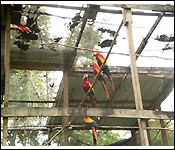
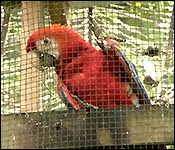
 Friends for Conservation and Development achieved another major milestone this week, executing one of its largest wild macaw releases into the Chiquibul Forest since 2012. Today, FCD's research coordinator spoke with us via Zoom to share the latest progress on restoring Belize's macaw population. Here is Jomarie Lanza with the story.
Since 2012, the Friends for Conservation and Development have been conducting biomonitoring of scarlet macaws in the Chiquibul Forest. Their work to safeguard the macaw species has significantly boosted the population of the birds, given that they are always at a high risk of being poached. They were caring for 19 birds, and yesterday they released 15 of those macaws back into the wild. Their research coordinator says that the birds they intake are the smallest in the nest and less likely to survive.
Wilmer Guerra, Research Coordinator, FCD
"These 15 macaws are a group of 19 at-risk chicks that we extracted this year which is an effort of monitoring that we do in the Chalillo, Chiquibul ecosystem. So these at-risk are basically at risk of being poached, or at risk of dying through other means we extract them and we bring them to our lab and then they go through a whole process of rehabilitation and then at the end they are soft released back into the Chiquibul wild."
 "So the macaws they usually nest in the riparian zone so along the riverbanks in Quamwood trees, these nests are quite high so what we do is we rappel up to the nests and then we basically biomonitor from the time that the macaw lays their chicks or the eggs to the time that the chicks hatch till eventually the chick flies off into the wild then we know that we have already made our part in documenting so that is basically what we do throughout the year, like I said in some instances we have already some established protocols with the Forest Department in which we want to intervene so we extract those chicks. We don't extract eggs so we only extract the chicks and we take them to the institute laboratory that we have in the Chiquibul forest reserve at Las Cuevas research station."
Placing chicks into their rehabilitation program has always been a last management option for the team at FCD. Guerra explains that the chicks undergo a short rehabilitation period of 100 days. But before they can fully integrate them back into the wild, they first have to learn how to fly.
Wilmer Guerra, Research Coordinator, FCD
"So for maybe for like the first 45-50 days we feed the chick only a special formula that is designed specifically for macaws and then we slowly start introducing wild fruits and other supplements for the chick to be able to learn how to forage out in the wild, and then at day 80-90 then we start to see the chick already flapping its wing then we know we have to transfer it to our bigger aviary and in that aviary the macaw would basically be able to practice its flight muscle until eventually at around 120 days we open up the gates and then they would fly off into the wild through a soft release program of course so we would still be able to provide food for the macaws while they have already fledged out of the aviary. So in some instances they would fly off and still come back in a period of about 3 days four days fly off again forage and then come back to our facilities so eventually they integrate into a wild flock and we don't see them again but it takes a process and then we basically have to work at the speed of how these macaws integrate back into the wild."
There are currently an estimated 350 scarlet macaws remaining in the wild across Belize.
|