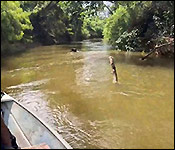
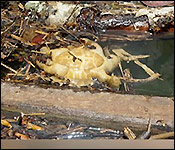
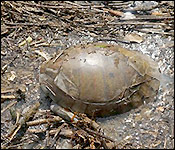
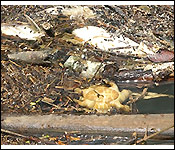
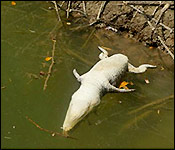
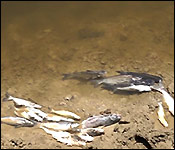
 It's been 2 weeks since a massive fish kill in the Belize River has left environmentalists stumped. It's not that fish kills are totally uncommon - it's more than magnitude of marine life - along with reptiles such as crocodiles and hickatees - that have gone belly up.
And today, the Ministry of Sustainable Development hosted a press conference where it provided its most detailed account of their investigation so far. But tonight, important questions still remain unanswered like what caused that oxygen depletion and what role did agricultural activity play? The biggest question, though, is where is the source of the fish kill?
Jaleeza Roberts reports.
It all began with a disturbing sight in the Belize River Valley, dead fish floating along sections of the river, with the heaviest concentration reported between St. Paul's Bank and Grace Bank. On August third, the Department of Environment received the report and deployed teams into the field. Their investigation considered three broad possibilities of disease, toxic contamination, or a heavy organic load entering the river. Disease, the Department says, is now considered highly unlikely which water samples along the river confirmed:
Anthony Mai, Chief Environmental Officer
 "We took samples from 150 meters upstream from Santander discharge channel at the channel, the canal, and then 150 meters downstream. We also took samples at St. Paul's Bank, Isabella Bank, Flowers Bank, and Burrell Boom. We also took samples from Santander effluent treatment pond, from the drainage network within the farm, and from the canal itself. So the water quality assessment was quite extensive. We conducted what is called in-situ sampling, that means sample on site. The data that we collected were data of the water quality at that point in time. And we also collected what is called grab sample. So we collected sample in a bottle.We brought these samples to our lab to get tested. In terms of the observation, we observed that the area between St. Paul's Bank and Grace Bank was the area most impacted. That is where we found most of the dead fish. And also the data will show that that is the area where the water quality was spurious, basically, as it relates to dissolved oxygen in particular."
And investigators are looking at more than one possible source, One area that has raised particular concern is a large rice field located north of Santander. The Department says the field is situated in a low-lying area and contains a canal through the middle of the operation.
That canal drains into Laboring Creek, which then flows directly into the Belize River. The concern is significant because rice cultivation requires flooded fields, and when that water is discharged, it can carry organic matter and other substances into surrounding waterways.
The Department says the configuration of this particular field makes the situation especially concerning:
Anthony Mai, Chief Environmental Officer
"So the Department of Environment did our internal checks, and we have found, at least according to our records, that the person does not have environmental clearance for this area, for the development of this area, which is a clear violation of the environmental regulations. A project of this size, in our estimation, would have required to undergo the EIA process. And so violation of that process, the penalty is between $50,000 to $100,000. And so what we will do is when we receive confirmation from the lands department that this person owns the land, we will still give the person an opportunity to provide any permits. That's the way how the process works. And if you can't, then again, the person will be held accountable for the violation."
But saying that it caused low oxygen levels would not fully explain how crocodiles and turtles ended up dying as well, as they use atmospheric oxygen:
Anthony Mai, Chief Environmental Officer
"Well, I had mentioned that, again, when an aquatic ecosystem, when the dissolved oxygen levels go low, it creates what is called an anoxic environment. And so in an environment like that, you have bacteria that thrive well without oxygen. They proliferate and they grow. And they produce hydrogen sulfide. And hydrogen sulfide could be one of the causes of the death of the turtle and the crocodile. And then the other possible cause is mycotoxins. So certain bacteria produces mycotoxins that are very harmful to aquatic life, basically."
And while reports said that Santander had a close looped system, one could only wonder what happens to anything needing to discharge when that system overflows and that's when the Chief environmental officer confirmed that it is not completely closed loop:
Anthony Mai, Chief Environmental Officer
"So the system is not 100 percent closed loop, per se.The effluent pond discharges into the drainage system. And the drainage system is where water is obtained for irrigation. So in a normal circumstance, it's enclosed. But it's when the area floods, that's when the water goes into the canal and then discharges into the river. But we have already started a conversation with Santander. So we have some broad things that we want to do, some broad corrective actions and Santander are coming up with some very concrete actions that they could put in place to avoid this from happening again. So one of the things that they have presented to us is completely ensuring that the effluent water from the factory itself is completely kind of - it's a circular system they want to put in place so it won't have any discharge, basically. But again, that doesn't resolve the issue of some of the farms in the future or an area of the farm still being flooded and organic matter still entering into the river."
The investigation into this is far from over as whatever is in the river goes to the sea. Jaleeza Roberts, 7 News.
Later, you'll hear what the department has to say about illegal crocodile feedings.
|