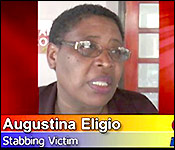
 She was a retired nurse at the time, but the love for the profession got her back into the work, only for a life-threatening attack to end her career in nursing.
Augustina Elijio was the former Deputy Director of Health Services, working on a contract as a psychiatric nurse practitioner in 2019 when a mental patient at the Port Loyola Clinic tried to kill her.
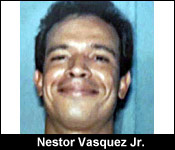
That same patient then murdered his cellmate two days later.
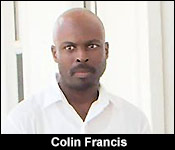
And that man, Colin Francis, was yesterday sentenced to 16 years' imprisonment for those crimes.
But how does Nurse Elijio feel about the sentence? And how did surviving the attack scar her forever?
Today, for the first time, we heard the story of survival from this veteran healthcare professional. Jomarie Lanza has this report:
When Colin Francis was sentenced yesterday to 16 years for the manslaughter of Nestor Vasquez Jr. and 10 years for the attempted murder of Nurse Augustina Elijio, Justice Nigel Pilgrim also included in his ruling that a psychiatric assessment found that Francis had diminished responsibility due to acute psychosis arising from schizophrenia. Francis is now left to serve nine years out of the 16-year sentence, having spent the last seven years on remand.
Brother of the deceased, Jules Vasquez, pointed to a failing system that led to the death of his sibling and the injuries sustained by Nurse Elijio.
After almost a decade, Nurse Elijio shared her story with us today-a traumatic recollection of June 4, 2019, the day that changed everything for her, which ultimately ended her career as a Psychiatric Nurse Practitioner:
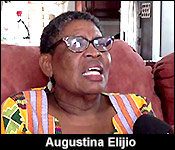 Augustina Elijio, Psychiatric Nurse Practitioner
"So we were winding down, we had patients there. And what had transpired is that this patient who inflicted those wounds to me, he came in in a very agitated state, you know, he was pacing and he wanted a certain drug, a certain medication. He was there earlier, so it was a concern like, why come back in the evening? So he started pacing, started becoming agitated, and before I know it, I was inflicted. I saw him fondling in his pockets, but I didn't think this person would be coming up with a knife. You know, sometimes it's good to follow intuition, but I said no, and before I knew it, I was stabbed multiple times. I was grounded-I was grounded. A very scary episode. I could hear a lot of screaming, my other colleagues, they were screaming. What had also happened is that he inflicted those wounds so fast that I could imagine... I could remember the first one being placed in my chest, another one in my stomach, the other one in the lateral side of my chest, in my side."
Nurse Elijio sustained severe damage to her torso and was rushed in for emergency surgery, but the complications that followed after, she describes, took both a physical and psychological toll:
Augustina Elijio:
"I later found out that he had lacerated my liver. The man also cut my diaphragm-that is the muscle sheet for you to breathe, you know-and some other organs in my abdomen, hence the reason one of the surgeries they did was an exploratory surgery. They opened me up to find out what all got affected, so that surgery, I must thank God, it went well until after I was discharged. In coming home, I had to get another emergency admission one week after coming home; I had some hematoma. Hematoma are namely the accumulation of blood in the sites just outside of your blood vessels, you know-those were some dark black blood clots. So I started bleeding in my sleep, you know, from my stomach, from my breasts, from my side. All the sites were bleeding profusely, so I was rushed back to emergency.
"It was a rough ride. It was a rough ride, you know, carrying those wounds, hurting, feeling anxious. Anxiety is a weird thing. What used to happen to me with my sleepless nights was that I used to get some odd smells like citrus oil, you know, in your sleep, like you can't breathe good, the fan is directly in my face, yet you are not breathing. So it gave quite a bit of ugly, ugly symptoms: sleeplessness, hopelessness, you know, you feel fatigued, you feel frightened. You get the flashbacks. Every now and then, I feel like this man is coming back to kill me, and I would jump out of my bed, and to this day, seven years later, I still get those flashbacks, still there.
"So the impact is great and it continues. And I am sure, I am certain this has nowhere to go. I continue to grieve. I grieve that incident, that I had... the image that I look at, when I look at my breast, when I look at my abdomen from those stab wounds, or even when I feel them, it feels ugly, you know. I have to live with that, so I am still grieving those things."
Years later, Nurse Elijio says she also had to absorb the cost of those long-term complications, ranging from high blood pressure to glucose complications, physical therapy, and medications not covered under NHI. And despite all she has endured, she says the incident never changed the love that she had for her practice and the 40 years in which she served in her profession:
Augustina Elijio:
"So I have had three different episodes, not to say that deterred me from doing what I like. I am in this country as a nurse because I like doing nursing, I like caring for my patients, and I never chose to leave like a lot of my colleagues-I stayed here. And it gives some satisfaction, but also there is some fears that goes along with it, especially when you are not... you feel like you are not protected. I heard Jules saying yesterday that the system needs to be fixed, and indeed the system needs to be fixed. And it needs to be fixed in some multilayers; there is a whole litany of things that needs to be fixed."
And when it boils down to the outcome of the trial and what has been called the lenient sentencing of Francis, Nurse Elijio is torn between two perspectives of the case: how she feels as a human being who survived a vicious attempt on her life, and a nurse who sees a patient in need of help:
Augustina Elijio:
"The answer for that is two-pronged for me. As a person, a human being, I, Augustina Elijio, I was hurt, I was stabbed, I saw death in front of my face. You know, my children would have been without a mother today, and the human aspect of you would just say, you know, that person needs to pay, to punish for what I went through. That is what the human aspect of me would say, even though I empathize with the family-they go through their own challenges in caring for their loved one-but that is how I feel as a human being. But when you look at the professional aspect of it, then I have to see it differently: someone who was vulnerable, someone who was probably hallucinating, someone who was probably delusional, and as a result was having these aggressive episodes. That person needs a lot of help. He needs his medication, his therapy, his family support.
"When you look at the term justice in a legal framework, it qualifies fairness, what is good, what's supposed to happen for a punishment as a wrongdoing. That is what justice say, you know. I wouldn't want to see that patient in a prison facility for punishment.
"So the sentencing is neither here nor there for me.
"I was never compensated. I was taken to our national referral hospital, Karl Heusner, where the Social Security Board covered my treatment-the cost of my treatment, my medication, and all that-that was as far as it had gone for me. I was hoping though, in looking at this whole scenario, I was in an environment where my safety, my protection was not adequate. So if I have to look at that, and if I have to look at that at a legal angle, that is tort: they didn't protect me, I was not protected, you know. So it is hard, but as I said, the only addressing as it covers my care was the costing at the hospital for my surgery, my medication, and those types of things."
|