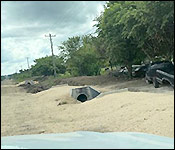
 If you travel the George Price Highway with any regularity, you will no doubt be aware of the ongoing roadwork.
A Harmonyville mechanic shop owner is protesting the removal of a culvert outside his business, which sits on squatter-occupied land within a 200-foot buffer zone along the George Price Highway.
The affected area stretches from the King's Children's Home to the Beaver Dam Bridge and includes a number of families who have been occupying land within the highway's buffer zone.
Today we spoke extensively with the chief engineer, who explained that the removal of certain culverts is based on road safety, access planning, and the need to avoid unnecessary expenditure:
Evondale Moody, Chief Engineer
 "So the policy is with the Ministry in terms of the projects that we're implementing is that once you have an access onto the highway, or once we have a driveway or a side road, those areas will be replaced with a new culvert to facilitate the drainage path that we have along the highway. Within the section that you're referring to, there is a buffer zone, which has a width of approximately 200 feet. And this is basically from the Children's Home all the way to the Beaver Dam Bridge. Within that buffer zone, which falls within Harmonyville, you have a number of individuals and families that are squatting within the buffer zone, right? And so what we have done is that the buffer zone itself has a back road, which is going to provide access to the residents that are currently squatting in the buffer zone. However, the contractor went ahead and started to put in culverts along that section because he saw that there were residents living within those areas, even though those residents are illegally living within the buffer zone. And so when we saw that, we had to pinpoint that out to the contractor that that was not necessary and that will, in an effort basically, has a significant, significant financial cost to the project because we're putting a number of culverts in that are not supposed to go there. We had to instruct him to go and remove some of those culverts. The ones that we have removed are the properties and houses where those individuals have either access to a road that is perpendicular to the highway, or they could get access from the back-where a new road will be put in place, and in some instances, that road is there as well already. The ones that are in place now is because we have squatters that have squat within the 200-foot buffer zone, but they're squatting behind each other, right? And if you're squatting behind each other, then the one at the front towards the highway will not have access to the back road because another family is already squatting there. And so in an effort to be lenient and also to be considerate with these residents, these are the ones that we have allowed the contractor to leave those culverts in place because there's no other way for them to have access onto the highway."
"The others that we have to remove is because we cannot have so many accesses coming directly onto the main highway, which will create a safety issue for the Ministry and also for motorists using the highway, because you have multiple accesses already onto the highway."
But the Ministry is not leaving these families in the lurch; they are developing alternative roads for them to access the land they're squatting on:
Evondale Moody, Chief Engineer
"Every other family that we have discussed this with are receptive to what we have explained to them, and they're of the fact that they're squatting within the buffer zone, which is not even official as yet. That is something that we have discussed with BGYEA and we have agreed with them to carry out an as-built survey to help them facilitate the cordial arrangement of those properties, because it has to be distributed to them, but it has to be surveyed before that is done. And that's where we are in terms of the culverts that we have removed within the Harmonyville area and those that have remained to be in place."
Reporter
"With these homes being located on this buffer zone, how will you solve this in the long term? Because construction will continue for a while. And so how will you continue? How will you solve this in the long term?"
Evondale Moody:
"Well, as a Ministry, our aim to solve this issue is for us to build that back road so that whoever was into the buffer zone will have access to that buffer zone from the road at the back. And so that's what we have agreed to do with those individuals to facilitate them in having access onto the highway. So yes, there's squatting there, and there may be other people that will encroach within that area, and so that is a discussion that has to be held between us and also BGYEA so that they could formalize what needs to be done and how those properties will be distributed to those individuals that are currently squatting there. As many of them... they are all squatters."
Reporter
"And so to be clear, they will not be getting back a driveway that is at the front of their property-or not their property, the place that they're staying, the place that they're squatting?"
Evondale Moody:
"No, those ones that have access from the rear will not be getting back an access, because we want to minimize as best as we can the number of accesses that we have entering the highway."
You can note that the Ministry has been issuing releases on removal of memorials and business signs from the buffer zones since January 28th.
|