 What is the future of Belize's judiciary, and will it be Belizean? That question has been brought into sharp focus tonight after former High Court Judge Antoinette Moore's sensational statement released yesterday. Moore has chosen not to comment further, but she doesn't have to, really-the statement gives voice to what many in the legal fraternity feel.
It has also sparked a battle in legal circles tonight over who will be Chief Justice next year, when current CJ Louise Blenman reaches the retirement age of 65. Sources tell us that while some well-placed lawyers favor an extension to her tenure, others want her gone.
Tonight, we look more closely at the statement made by former Justice Moore and the responses to it:
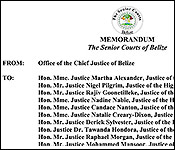
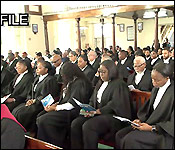
This routine internal memo from the High Court to its judges from a few days ago effectively displays how totally stacked the bench is with foreign judges-a dozen foreign judges-and they are summoned to meet with the Chief Justice, also a foreigner. In fact, no Belizean has substantively held the post of Chief Justice since Manuel Sosa in 1999-two Belizean jurists have acted.
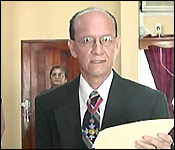
And that's what former Justice Antoinette Moore-who retired from the High Court in August-is talking about in this bombshell statement issued yesterday, innocuously titled "From My Chambers."
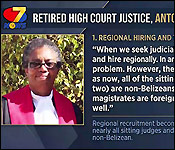
It says, "When we seek judicial officers, we search and hire regionally. In and of itself, this is not a problem. However, the concern arises when, as now, all of the sitting judges (except two) are non-Belizeans and now many of our magistrates are foreign-born as well."
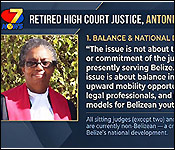
She then gets to the heart of the matter, explaining, quote, "The issue is about balance in the judiciary, upward mobility opportunity for Belizean legal professionals, and providing role models for Belizean youth. The question is about who is not on the bench and what this means for Belize and her future. From my perspective, the question of who a country selects to preside over its courts, to fill out its third branch of government, is a matter of national development. Who you give the responsibility to interpret your laws, to resolve disputes, and to decide the most serious criminal matters in your society is critical. This is one of the many indicators of the maturation of an independent people and country."
Moore urges decision-makers in the executive and the judiciary to look within, saying, "We now have a pool of experienced Belizean lawyers of good character who could serve in the judiciary. We have, however, chosen over the last four years to exclude all possible candidates. We have transformed the judiciary into being almost exclusively non-Belizean…"
From this, she reaches a dismal but ineluctable conclusion: "If the current cadre of judges remain and there is no increase in the number of judges on the High Court, there will be no opening for a Belizean magistrate or lawyer to become a High Court judge for many years to come."
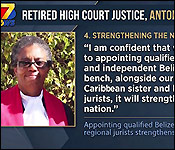
A sobering and very real conclusion, and Moore ends on an optimistic note, quote: "I am confident that when we return to appointing qualified, uncompromised, and independent Belizeans to the bench, alongside our Caribbean sister and brother jurists, it will strengthen the nation."
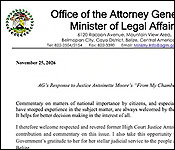
In a response this afternoon, the Attorney General didn't say much in response to these pinned criticisms, only, quote, "While I do not agree with every aspect of Justice Moore's critique, I agree with Justice Moore's point of the need for balance… Consequently, in September, it communicated to the Bar Association of Belize, the Association of Defence Attorneys and the Judiciary, of its intention to move an amendment to section 110E of the Constitution, to expand the membership of the Judicial and Legal Services Commission (JLSC) with the aim to foster a more balanced deliberation by that body which appoints and disciplines judicial and legal officers."
The response goes on to outline policy adjustments-but steers clear of the existential question put forth by Moore's statement: Are we mature enough as a nation to entrust our highest courts to our own?
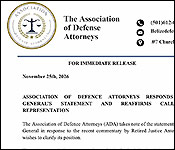
This evening, the Association of Defence Attorneys issued its release responding to the statement of the Attorney General.
First, they applaud Retired Justice Moore for her, quote, "thoughtful and important contribution to the national discussion on the composition of Belize's judiciary. The ADA fully endorses the position articulated in her commentary."
They add, "With respect to the proposed changes to the Judicial and Legal Services Commission (JLSC), the ADA wishes to make one matter abundantly clear. What was communicated and promised to the Association was that it would be placed on equal footing with the Bar Association of Belize on relevant legal bodies. The Association did not advocate for, nor was it promised, some form of rotating representation shared with other organizations, including organizations that may be established in the future."
|