And so while there are rugged days ahead for BTL, it sounds like competition to us, which is always good news for consumers. Both companies acknowledge that the proposed consolidation was hugely unpopular and so did Cabinet in its release yesterday when it formally withdrew support for the acquisition.
But how did Cabinet arrive at that decision? They were supposed to meet next Tuesday to decide-but, sensing a gathering storm on the horizon, the PM seems to have just made a snap decision in an Orange Walk minute.
Today PUP Chairman Henry Charles Usher says he supports the decision, acknowledging that he had reservations about the acquisition:
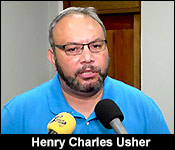 Henry Charles Usher, PUP Chairman
"The decision made by Cabinet yesterday is an informed decision. It's a decision that I support. It's a decision that came out of many, many consultations with different stakeholders, both individually by Cabinet members reaching out to different stakeholders and collectively. I supported the Prime Minister and I continue to agree with his position that we had to hear from the different stakeholders as a collective unit. And it was important that we heard from BTL, from SSB, from PUC on the development since we last heard from them in January or February. And what I can say is that out of these presentations and the questions, the issues that were raised, we were able to reach a consensus yesterday. We had hoped to hear from other stakeholders, but we couldn't work out the logistics of that. But we were able to reach a consensus and like I said, it's a decision that I support."
Jaleeza:
"What were your personal thoughts on this acquisition and did you support it?"
Henry Charles Usher:
"So from the very beginning, as I had explained to you before, I had my reservations about the proposed acquisition. And that came out of my consultations with the ultimate owners of this, of the company, the people of Belize, constituents of Fort George. I had many discussions with them, but also because I had spoken to a number of the stakeholders when it came to the uncertainty in the legislation, uncertainty in the regulation. Of course, you know, much has been said about Section 42 (4) of the Telecommunications Act. There was some uncertainty about how we would move forward if there was only one traditional telecoms company, but also because I know globally that the traditional, what they call a terrestrial telecommunication companies are facing an existential threat. And we have to be able to prepare for that. The technology is moving very fast. We are moving away from the tower base operators to what they call mobile virtual network operators, the MVNOs. And we have to be able to keep up with that technology."



 Email
 Print